The Dark Side of Botox

Biology is biography
Our body is our biography: be careful what you edit and delete.
Around the world, Botox shots are being injected, and will keep being given, to millions of fans of synthetic anti-
aging. Botox parties with many participants are only getting more and more popular. But this “beauty” strategy has a dark side.
Not only does it destroy facial nerves and muscles, it may also alter human cognition, emotion and perhaps even empathy…
Botox is a rather strange phenomenon. Because at present, it is the only treatment approved by the US Food and Drug Administration for making moderate to severe wrinkles, crow's feet and forehead lines look better in adults.
And even though it was approved, it carries serious warnings about severe and even life-threatening side effects, as published about the manufacturer, the Allergan company.
Problems such as difficulty swallowing, speaking or breathing, due to muscle weakening, can be severe and even cause death. If these problems existed before the injection, the risk rises exponentially. Swallowing problems can last for several months.
The effect of botulinum toxin may reach areas far from the injection site,
and cause severe symptoms including: loss of strength and general muscle weakness, double vision, blurred vision and drooping eyelids, hoarseness or change or loss of voice, trouble saying words clearly, loss of bladder control, breathing difficulties and swallowing problems.
These side effects seem like an especially high price to pay for the promise of merely temporary “improvements” in the natural signs of aging.
There is no doubt that its ever-growing popularity, fed by its widespread adoption by celebrities and by everyone who copies them day after day, “contributes” to the consequences being ignored.
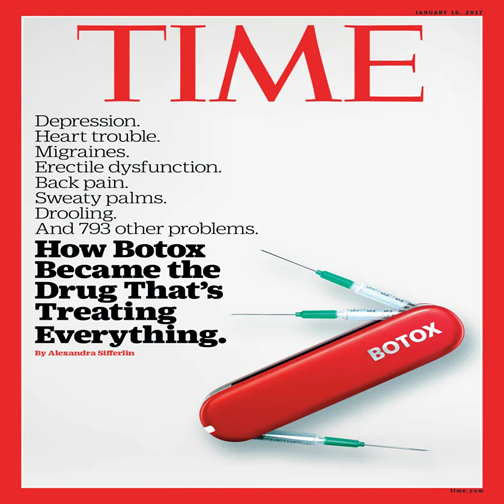
It certainly doesn't help that mainstream tabloids like Time magazine, in its January 2017 issue, praise its benefits with a cover story, “How Botox became the drug that can treat everything,” claiming it can treat hundreds of different conditions.
With this kind of “free” publicity, it's no wonder that global Botox sales hover around three billion a year, great business for the manufacturer but bad for our nerves. But with the growing popularity of a supposedly cosmetic intervention whose mechanism of action is the destruction of nerves, it is worth shedding light on the unwanted and negative effects of this trendy product, which has become a social status symbol.
At the level of bodily function, it is now known that botulinum toxin can travel quickly beyond the injection site directly into the central nervous system.
Recent studies have found that Botox actually travels into our nervous system. That's no surprise, since it is a toxin with a strong affinity for nervous systems…
Botox supporters claim that the amount of botulinum given is too low to raise safety concerns. But the margin of error when it comes to safety is especially hard to determine with botulinum toxin, because it is the most powerful neurotoxic substance known to us.
In fact, it takes only 75 billionths of a gram to kill an adult weighing 75 kg.
It is estimated that just one kilogram of it would be enough to kill the entire human population!
Different people have different degrees of sensitivity to botulinum toxin, which makes it even
harder to apply a one-size-fits-all toxicological risk model to it.
The side effects are rare, but they are catastrophic for the nervous system.
In the past decade, the manufacturer, the Allergan company, was ordered to pay a man in the state of Virginia $212 million in compensation for harm caused by Botox.
Here is a translation of what the manufacturer prints, in black and white, on every Botox package:
“The effects of botulinum toxin products may spread from the area of injection to produce symptoms consistent with botulinum toxin effects. These symptoms have been reported hours to weeks after injection. Swallowing and breathing difficulties can be life threatening and there have been reports of death. The risk of symptoms is probably greatest in children treated for spasticity, but symptoms can also occur in adults, particularly in patients who have an underlying condition that would predispose them to these symptoms.”
However, it turns out, after years of repeated use of this toxin on the face in the critical areas of expression, that it also has a far-reaching effect on the consciousness and the mental-emotional state of those injected.
Consider what we have learned only in recent years about fluoride, which has been linked to increased calcification of the pineal gland, the neurobiological seat of the “third eye,” and which can destroy our awareness, our IQ and our ability to appreciate the nuances of the human condition. Another example is Tylenol (in Israel, Acamol and Dexamol), used at a rate of billions of doses a year worldwide, which has been found to have profound and harmful psychiatric side effects: flattening our humanity and reducing empathy!
It turns out that a growing body of clinical research shows how Botox injections affect more than just the physical surface of the facial musculoskeletal system and the nervous system; they also change the way the human brain responds to emotional situations, as well as aspects of cognition. And even the processing and understanding of language itself. In other words, the damage caused by Botox injections directly, and perhaps deeply, affects human consciousness and changes it.
The implications of this research are deeply troubling. Millions of people have likely experienced emotional and cognitive changes from these injections, and they were not informed of the risks… for example, that Botox also alters consciousness by disrupting facial feedback (the principle that feedback from the skeletal muscles involved in facial expressions plays a causal role in regulating emotional experience and behavior).
Biology is biography. Your body is your biography: be careful what you edit and delete. Using Botox to change or erase the physiognomic text of the face will have emotional/cognitive consequences that may affect perception and behavior.
Perhaps we need to remember that while wrinkles today have become erasable marks of pathology, to which establishment-approved nerve-destroying treatments are applied, signs of character, and perhaps of wisdom, reflect a different kind of beauty: the beauty of the soul.
Sources:
A 2014 study titled, "Altered cortical activation from the hand after facial botulinum toxin treatment," found that Botox-induced loss of facial movements alters the cortical circuits involved in processing tactile inputs from the hand. The researchers concluded: "This suggests that the limited paralysis of facial muscles induced during cosmetic interventions designed to smooth lines and wrinkles on the face is sufficient to alter the cortical processing of tactile inputs from the hand.“
- A 2009 study titled, "The link between facial feedback and neural activity within central circuitries of emotion--new insights from botulinum toxin-induced denervation of frown muscles," found that Botox treatment reduced the activation of the left amygdala and its functional coupling with brain stem regions implicated in autonomic manifestations of emotional states.
- A 2010 study titled, "Cosmetic use of botulinum toxin-A affects processing of emotional language, reveals that Botox-induced blocking facial expression by peripheral denervation of facial musculature selectively hinders emotional language processing.
- A 2011 study titled, "Embodied Emotion Perception," found that Botox injections dampened emotion perception by interfering with muscular feedback from the face, effectively interfering with their ability to empathize.
- 2014 study titled, "Botulinum toxin-induced facial muscle paralysis affects amygdala responses to the perception of emotional expressions: preliminary findings from an A-B-A design, " found that Botox affects emotional experience by interfering with the feedback signals from facial muscles. Specifically, Botox interfered with amygdala activity, a part of the brain's limbic system associated with memory, survival instinct, and emotions in general.
- 2016 study titled, "Deeper than skin deep – The effect of botulinum toxin-A on emotion processing," found that emotional stimuli were blunted after Botox use, and that they became slower at categorizing emotional facial expressions under time pressure.
- https://time.com/magazine/us/4623396/january-16th-2017-vol-189-no-3-u-s/
- https://www.statista.com/statistics/737477/global-sales-of-allergan-s-botox/
- https://www.jneurosci.org/content/35/15/6179
- https://www.sciencedaily.com/releases/2015/04/150416094051.htm
- https://www.citizen.org/article/petition-requesting-regulatory-action-concerning-the-spread-of-botulinum-toxin-botox-myobloc-to-other-parts-of-the-body/
- https://www.rxabbvie.com/pdf/botox_pi.pdf
- https://greenmedinfo.com/blog/fluoride-calcifier-soul
- https://greenmedinfo.com/blog/tylenol-kills-emotions-well-pain-study-reveals
- https://www.ncbi.nlm.nih.gov/pubmed/1271216
A new article every week, straight to your inbox.